Rebel at the Table: Church Visit #2

Janice went to help our daughter lead worship at our old church. I didn’t want to go because, in the spirit of rest during my sabbatical, I’m trying to avoid attending churches where people know me. Anonymity feels like rest.
So, I had a Sunday to go to church on my own. I decided to go to the local Catholic Church. It had been a long time since I’d visited the tradition of my youth. I was baptized in the Catholic Church as an infant, but I could count on one hand the number of times we went to Mass as a family. But strangely, everything felt familiar, from the holy water you dip your fingers into, to the echoey acoustics, to tripping over the pew kneeler on your way to finding a seat, to using the missal to know what to say, when to say it, when to stand, kneel, sit, etc.

I became a low-church guy in part as a reaction to what I regarded as rote and therefore inauthentic worship. I don’t feel that way anymore about scripted liturgies, even as I remain a jeans-and-t-shirt, spontaneous, acoustic-guitar-and-harmonica kind of worshiper. Still, I found the experience on the whole at St. Paul’s meaningful, nourishing, worshipful.
A few things stood out. I noticed, first, how the service was equal parts word, participation, and tactility. Meaning that it didn’t feel sermon-dominated. There was a sermon, but it wasn’t central; it was just one part of the whole. It was only 10 minutes long! Maybe 11. In all the churches I’ve ever joined or served since coming to faith, everything that happens is somehow related to the sermon or the theme of the sermon, from the welcome to the songs to the prayers to communion to the benediction. So, I found it remarkable that the ministry of the word didn’t dominate the experience.
The sermon itself was also noticeable. Did I mention that it was only 10 minutes long? Besides that, it was the only time the priest seemed human. During the rest of the service, he seemed more like a supernatural mediator between God and us. He performed sacred duties such as turning the wafers into the flesh of Christ and the wine into the blood of Christ. But when he preached, he became one of us. The word made flesh. He cracked jokes. He used plain language. He told a story of a cousin who lost her faith when she was diagnosed with cancer, and how the faith community helped her overcome her anger. She died in peace.
When it was time for communion, my mind went immediately to my mother’s funeral in 1999, where I was denied the elements because I wasn’t Catholic. When I came back to the present, I resolved to partake no matter what. For mom. For 27 years of bottled-up resentment. With rebellion in my heart, I joined the line. As I inched forward, I was surprised how undeterred I was to do something I knew the Catholic faithful wouldn’t have approved of in their house.
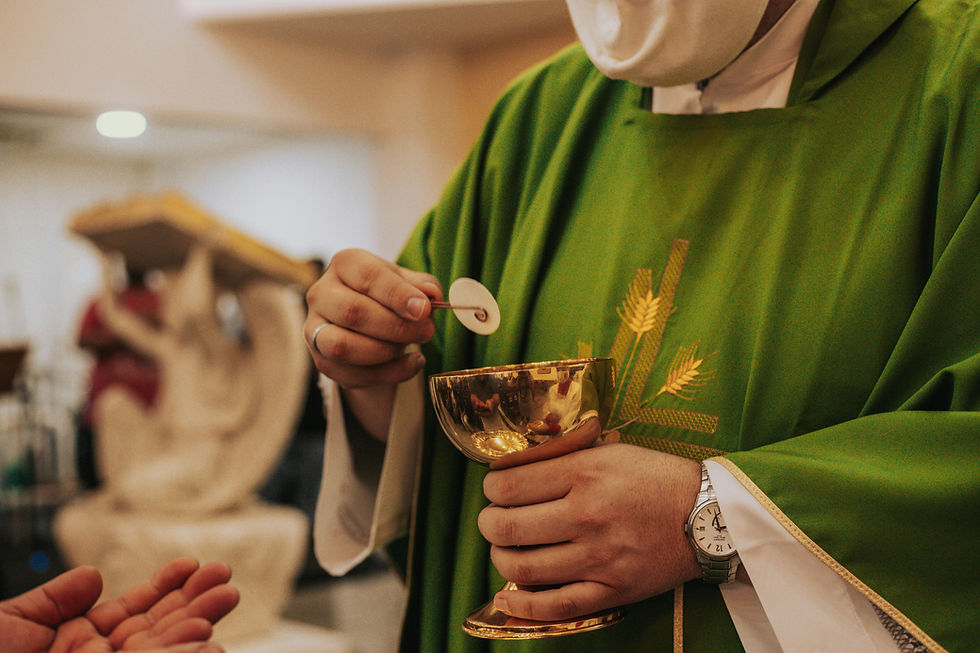
“The body of Christ,” said the server.
“Amen,” I answered. With anger, resentment, and defiance in my heart, I put the wafer into my mouth. If it weren't so despicable, it’d be funny. Quintessential irony. I basically partook of the body of Christ while giving the Catholic Church the finger. It didn’t bother me until later in the week; in fact, I didn’t even think about it until the Wednesday after. Which makes me think the Spirit brought it to my attention. I felt convicted. Good thing the Table is about forgiveness, because I needed it.
Forgive me, Lord.
My unspiritual behavior aside, I do plead with all churches—Catholic, Orthodox, and Protestant—to open the Table for all. It’s the one place where we must set aside our differences and declare together, “I believe in one, holy, catholic and apostolic Church. I confess one Baptism for the forgiveness of sins, and I look forward to the resurrection of the dead and the life of the world to come.” It's also the place where we can invite the lost to Jesus.
The Table represents the unconditional love of God for all; please don’t put conditions on it. Together, let’s bear witness to the Love that saves, heals, unifies, and transforms.
Forgive us, Lord.


I love your honesty, Al!